
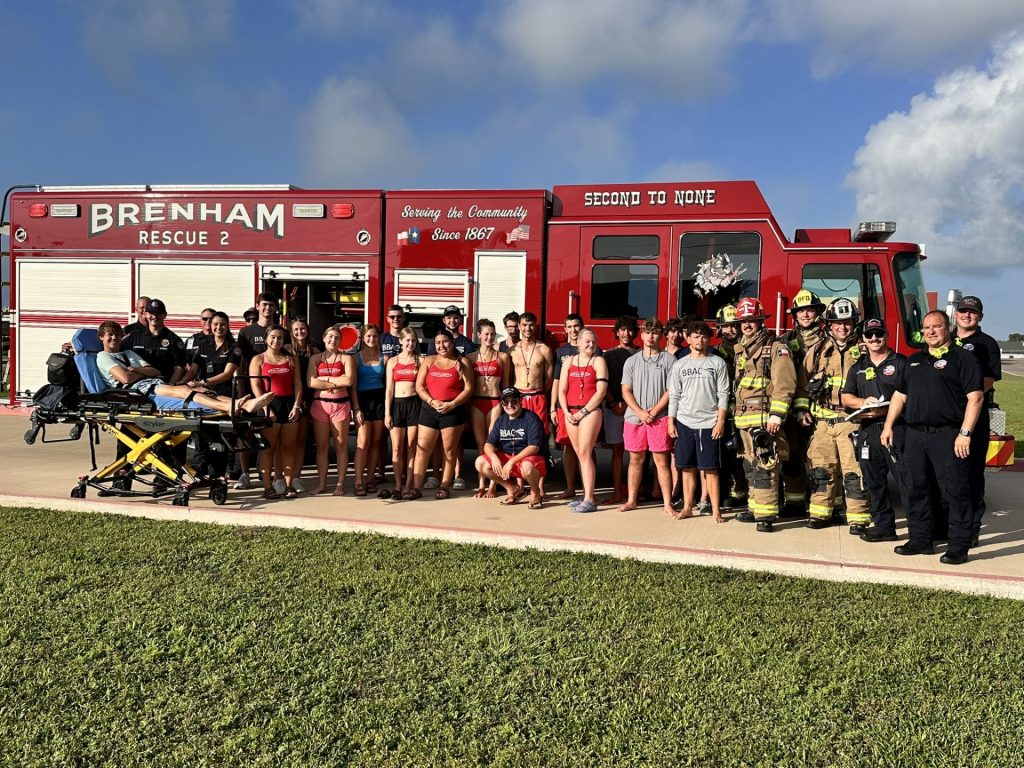
Everyday, lifeguards face a certain reality: In an true emergency, hesitation isn’t an option. These professionals must know how to perform under pressure.
Knowing this, management at the City of Brenham’s Blue Bell Aquatic Center developed its lifeguard training to include drills that increase adrenaline and provide a better sense of how a real situation might unfold and feel.
Drills happen while the facility is open to the public, to introduce unplanned challenges and distractions. They also vary to test readiness, response type, and response time.
Kelsey Toy, assistant aquatic superintendent of the facility, identifies a specific influence for this strategy. “A lot of my drills like that come from Pete DeQuincy,” she explains, referring to the lifeguard trainer, aquatics manager and Aquatics International columnist.
For years, Brenham has sought to replicate the stress of a real emergency. “You make a mistake, you start over right away … there’s no break,” she says. “We change the way we start them. Sometimes you say ‘Go,’ or sometimes you’re just counting, and they’ve got to figure out how you’re starting it at that minute.”
Partnering for preparedness
Three years ago, the center introduced another move to deepen the training, as well as prepare guards to work with local emergency professionals during emergencies.
It began training with the City of Brenham Fire Department, Washington County EMS, the City of Brenham Police Department, and Washington County 911.
“We all work for the city, so we want to make sure everybody’s prepared and safe as much as possible, so we work together really well,” Toy says.
The collaboration, which happens at least annually, has led to full-scale, multi-agency drills designed to mirror large-scale emergencies. The scenario changes each year — one time it was a fire in the pump room, another a hazardous materials incident.
The most recent event simulated a muriatic acid spill, complete with “victims,” evacuations, and emergency response coordination across multiple departments. The different departments had to react quickly and manage an evolving scene. Lifeguards had to determine safe staging areas based on wind direction, which tested their ability to adapt in real-time.
Only the leadership of each department knows when the drill will occur.
“The rest of the departments, other than being told it’s a training when the call is dropped, have to go on instinct and learn as they go,” Toy says. That element of surprise keeps adrenaline high and reactions authentic.
Lessons learned
Drills end with a postmortem meeting where the agencies talk about what each crew could do differently or better.
This year, Toy’s team learned they could improve their 911 calls. “They were all a little panicked, and that 911 call was not pretty,” she says. The staff also forgot to contact management afterward.
This realization prompted the staff to establish an alert system with dispatch. “Anytime a call is made for our facility, they are to call [me] and the superintendent,” Toy explains. Now there is a backup alert if staff forget to call.
Practicing scenarios that raise adrenaline has paid off. The lifeguards have gained confidence in their ability to apply what they’ve learned and work with other departments during a crisis.
“The biggest thing I noticed is the confidence in my staff to be able to do what they already know how to do,” says Toy.
The inter-departmental drills and their important lessons would not be possible without the partnership and buy-in of leadership in other departments. “Their continued collaboration is essential to our success,” Toy says.