From the time Pulte Homes broke ground on Windsor Cay Resort in Clermont, Fla., the waterpark was never treated as an afterthought. The 693-unit vacation-rental community—positioned just minutes from Disney World and Universal Studios—was conceived from the outset with a full-service aquatic amenity at its core. That decision, made at the development planning stage, is an important consideration for commercial aquatic consultants advising mixed-use resort or short-term rental communities.
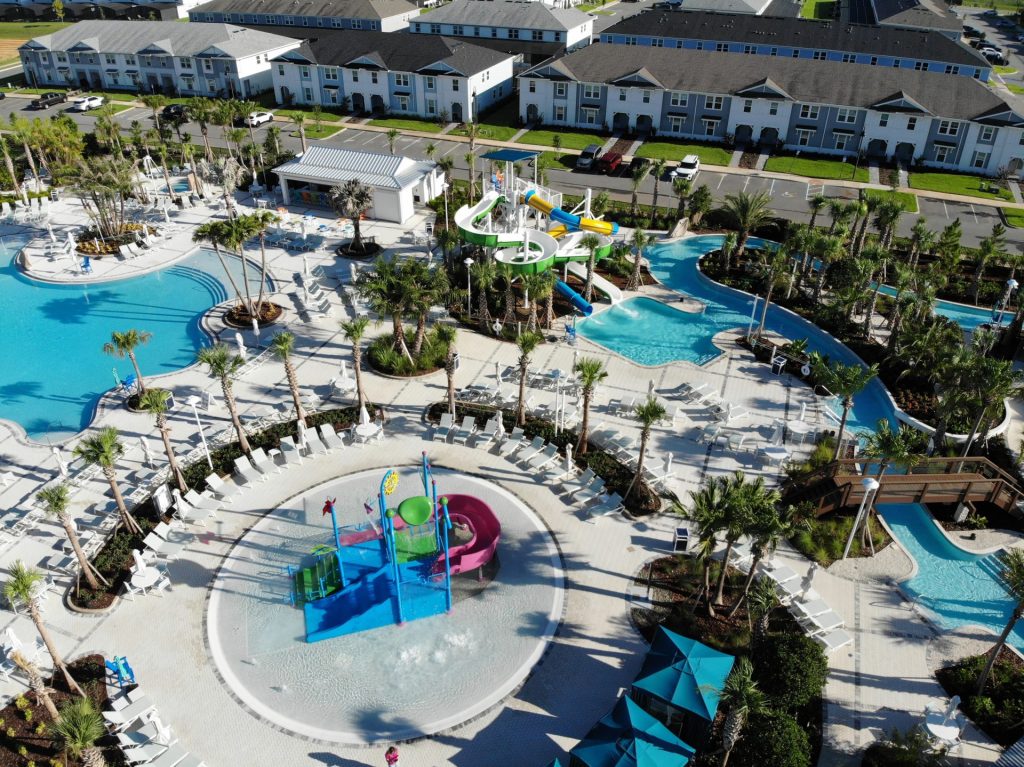
The project team assembled for Windsor Cay included waterpark contractor Village Pools of Central Florida, JK2 Construction, WET Engineering, AquaWorx, and Water Odyssey. The result is a cohesive aquatic environment featuring a dual-flume waterslide, a multilevel interactive water play structure, a winding lazy river with propulsion, and a dedicated swimming pool—all tied together by a centralized filtration and mechanical infrastructure system.
For builders and consultants, the significance is clear: Integrating aquatic amenities into community planning creates the opportunity for mechanical systems, structural supports, and programming zones to be coordinated for optimal performance and long-term operational efficiency.
In vacation-rental communities, waterparks can serve as differentiators with their ability to transform a property into a destination in its own right. Engaging, on-site recreation encourages guests to spend more time on the property, creating opportunities to extend stays, increase on-site spending, and enhance overall guest satisfaction. Positioning aquatic infrastructure within the master site plan—rather than as an add-on—also allows mechanical systems and cross-brand features to be coordinated from the design phase forward.
Multilevel play structure
One of the more technically detailed elements of the Windsor Cay project is the multilevel water-play structure at the heart of the kiddie pool zone. What makes it distinctive for commercial aquatic builders is not just its visual impact—it is the deliberate integration of products from two separate brand families into a single, cohesive structure. AquaWorx manufactured the custom fiberglass play structure while integrating Water Odyssey’s decorative spray features throughout the design, creating a cohesive play environment that blends interactive water play with a unified visual aesthetic.
The structure combines slides and interactive spray features, including a large water bucket that creates an overhead water release, as well as a rotating water-play feature that invites guest participation. Coordinating these elements within one play structure enabled the project team to create programming for multiple age groups while maintaining a cohesive visual and operational design.
Surrounding the structure, ground sprays are positioned directly on the pool floor to extend the interactive zone beyond the structure itself, encouraging movement, discovery, and multi-directional engagement.
The integration of AquaWorx and Water Odyssey components demonstrates how features from separate product lines can be combined into a single play structure. Strategic component mixing—when coordinated by experienced aquatic designers—allows consultants to maximize play value, hit specific age-group programming targets, and create visually distinctive structures that differentiate one resort from the next.
One structure, many experiences
Windsor Cay’s dual-flume waterslide combines open and enclosed flume options within one attraction. For commercial aquatic consultants, the feature illustrates how different slide experiences can be incorporated into a single structure.
The color scheme—vibrant yellow, green, white, and blue—is a visual anchor for the waterpark. The ride also includes a dispatch system based on red-light/green-light sensors. The system helps lifeguards manage rider intervals and is intended to support consistent slide operations during variable guest volumes.
At Windsor Cay, the sensor-based dispatch system was incorporated into the slide installation during design and construction, enabling coordination with the slide structure’s hydraulic and operational controls.
Riders exit the slide directly into the lazy river, providing a direct transition that helps improve overall guest flow and reinforces the interconnected nature of the waterpark layout. That deliberate exit-point integration is a design decision with real operational consequences: It helps reduce bottlenecks at slide bases and encourages guests to continue engaging with the attraction loop.
Lazy river propulsion
An especially sophisticated technical element of the Windsor Cay waterpark is the lazy river propulsion system. The lazy river is powered by subterranean river thrusters, a mechanically concealed approach that supports water flow while minimizing the visibility of propulsion equipment to guests.
The thrusters are camouflaged in green to blend with the surrounding landscape, an intentional design choice that preserves the space’s resort-style appearance. For commercial aquatic consultants designing for hospitality or vacation-rental communities, this approach provides an example of mechanical concealment within a guest-facing water feature.
Centralized mechanical infrastructure
A waterpark’s long-term operation depends
in part on the reliability of the filtration and mechanical systems that support it. At Windsor Cay, a centralized hub brings together water-quality management, slide pumping stations, and hydraulic controls for the interactive
water features.
Locating these functions within a coordinated mechanical infrastructure system supports the project’s overall approach to integrating aquatic attractions and operations from the outset.
For consultants, Windsor Cay illustrates how filtration, slide pumping, and hydraulic controls can be addressed during initial project planning as part of the broader aquatic amenity plan.
Related resort-community planning strategies
Windsor Cay was designed with explicit reference to the nearby Windsor Island Resort. For commercial aquatic builders working with real-estate developers, the relationship between the two communities illustrates how a developer may apply a similar amenity concept across related vacation-rental projects.
For builders and consultants, projects such
as Windsor Cay demonstrate the value of experience with resort-integrated aquatic environments and coordinated project teams. That experience may be relevant when developers consider similar amenity-driven community projects.
The collaboration among AquaWorx, Water Odyssey, and Village Pools of Central Florida demonstrates the coordination required
when a project combines cross-brand play features, concealed mechanical systems, and programming for different guest groups.
Community-level aquatic planning
Windsor Cay Resort illustrates how a waterpark can be planned as part of a vacation-rental community rather than added after the broader site plan is established. The project brings together a dual-flume waterslide, a multilevel water-play structure, a lazy river, a swimming pool, and centralized mechanical infrastructure within a coordinated amenity area.
For commercial aquatic builders and consultants, the project underscores the importance of early coordination among attraction programming, structural requirements, mechanical systems, and the project team. Windsor Cay also demonstrates how cross-brand features and concealed propulsion equipment can be incorporated within a unified resort-waterpark design.