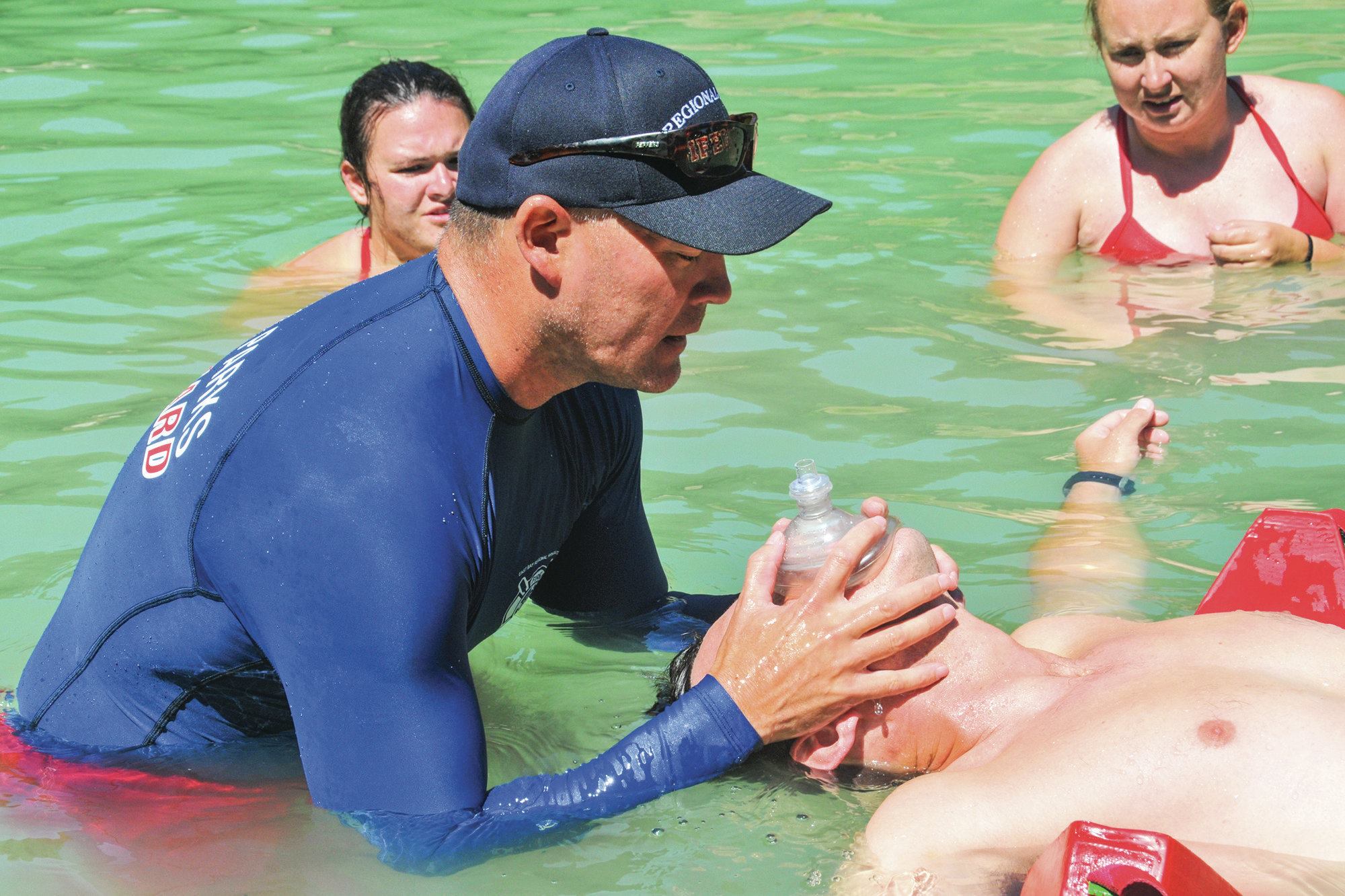
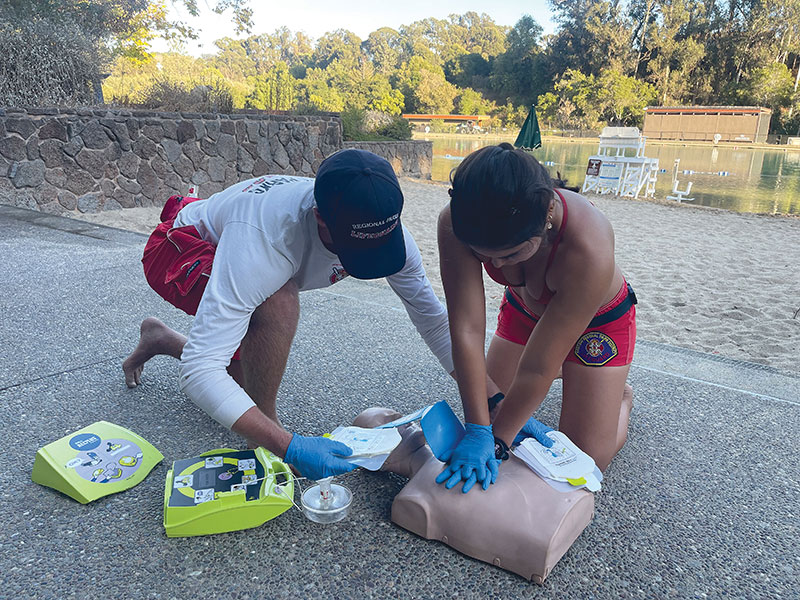
To increase the chances of survival for individuals in cardiac arrest, lifeguards must gain proficiency and endurance in delivering high-quality CPR. The following is a review of some of the objectives that the American Heart Association (AHA) encourages teams to strive to achieve and perfect:
- Begin compressions within 10 seconds after recognizing cardiac arrest
- Compress the chest hard, and compress it fast; around 100–120 compressions/minute
- Compress the chest to a depth of at least 2 in. but no more than 2.4 in. for adults, approximately 2 in. for children, and approximately 1.5 in. for infants
- Allow for complete recoil of the chest after each compression
- Minimize interruptions during compressions
- Give effective breaths, with the delivery of each breath being roughly one second, and each breath providing enough volume to make the chest rise
The two in-services below focus on developing proficiency, speed, and endurance when providing CPR to an adult Guest in Distress (GID) found on land. The first in-service focuses on building proficiency and endurance for the solo rescuer. The second is designed for two-person rescue teams, when both guards arrive on scene simultaneously. It focuses on building teamwork and incorporating the use of an automatic external defibrillator (AED).
The Lean format
These drills are of the Lean In-Service variety, meaning they only take 15 minutes. These are designed to maximize time while isolating and focusing on one small skill. The chart below shows how these are formatted, with each component described.
Summary of the 15-minute in-service framework
| 15-minute IN-SERVICE: Topic | ||
| Introduction | 1 minute | |
| Skill #1 | 3 minutes | Benchmark to be achieved |
| Skill #2 | 3 minutes | Benchmark to be achieved |
| Skill #3 | 3 minutes | Benchmark to be achieved |
| Skill #4 | 3 minutes | Benchmark to be achieved |
| Closing | 2 minutes |
Introduction
The introduction should provide the set-up and explanation of the first skill or activity.
Skills
Skill blocks should focus on developing one specific skill.
Closing
Allows the trainer to provide feedback to lifeguards on their skills, the trainer’s goal, and how the in-service aligns with overall job duties.
Benchmarks
This module outlines what the trainer hopes to achieve within the skill block. This can include a specific skill acquired or a timing goal to be met.
| 15-minute in-service: High-quality CPR – Adult on land | ||
| Introduction: High-quality CPR for a solo rescuer
Note: This in-service should be conducted continuously without a break. |
1 minute | Provide a brief explanation and demonstrate the rescuer’s position in relation to the CPR manikin. |
| Skill #1—One rescuer will provide a primary assessment, followed by 30 seconds of CPR
Provide one rescuer and one resuscitation mask for each CPR manikin. The manikin should be equipped to provide real-time data and feedback on the rescuer’s CPR performance. |
3 minutes
3 reps minimum, striving for 4 reps or more |
Benchmark: Rescuer can successfully perform a primary assessment, activate EMS, and provide one cycle of CPR (30 compressions and two effective ventilations). |
| Interlude activity—Assign a different CPR manikin for Skill #2. | 10 seconds | Benchmark: The rescuer should move quickly to another CPR manikin. |
| Skill #2—One rescuer will provide a primary assessment followed by 1 minute of CPR.
Provide one rescuer and one resuscitation mask for each CPR manikin. Manikins should provide feedback to the rescuer. |
3 minutes
2 reps minimum |
Benchmark: Rescuer can successfully perform a primary assessment, activate EMS, and provide one minute of CPR (2 to 3 cycles). |
| Interlude activity—Assign a different CPR manikin for Skill #3. | 10 seconds | Benchmark: The rescuer should move quickly to another manikin. |
| Skill #3—One rescuer will provide a primary assessment, followed by 2 minutes of CPR.
Provide one rescuer and one resuscitation mask for each CPR manikin. Manikins should provide feedback to the rescuer. |
3 minutes
1 rep |
Benchmark: Rescuer can successfully perform a primary assessment, activate EMS, and provide 2 minutes of CPR (5 cycles). |
| Interlude activity—Assign a different CPR manikin for Skill #4. | 10 seconds | Benchmark: The rescuer should move quickly to another manikin. |
| Skill #4—One rescuer will provide a primary assessment followed by 2 minutes of CPR.
Provide one rescuer and one resuscitation mask for each CPR manikin. Simulated patients should provide feedback to the rescuer. |
3 minutes
1 rep |
Benchmark: Rescuer can successfully perform a primary assessment, activate EMS, and provide 2 minutes of CPR (5 cycles). |
| Closing | 2 minutes | Provide feedback and remind lifeguards how the training aligns with effective care for the GID. |
| 15-minute In-service: Two-rescuer CPR/AED | ||
| Introduction: High-quality CPR for a two-person rescue team that arrives on scene for an unresponsive GID on land. A training AED, radio, or mobile phone will be utilized. | 1 minute | Provide a brief explanation and demonstrate the rescuers’ roles, tasks, and body positions around the CPR manikin. |
| Skill #1—Calling 911
Provide two rescuers and two resuscitation masks for each CPR manikin. Manikins should be made to provide data and feedback to the rescuers. Also provide one training AED and a radio or mobile phone for activating 911. |
3 minutes
4 reps minimum, striving for 6 reps or more Rescuer 1—caller Rescuer 2—911 dispatcher After 1 rep, rescuers will switch roles and repeat. |
Benchmark: A rescuer calling 911 should be able to identify themselves and the location of the emergency, describe the nature of the emergency, explain what is being done for the GID, what resources are needed, and the best access point to reach the GID. This should be done clearly and calmly. |
| Skill #2—Rescuers will provide a primary assessment, activation of EMS, and 1 minute of CPR.
Provide two rescuers and two resuscitation masks for each CPR manikin. Manikins should provide feedback to the rescuers. Also provide one training AED and a radio or mobile phone for activating 911. |
3 minutes
2 reps minimum, strive for 3 reps, switch roles between reps. Rescuer #1—provides a primary assessment, determines GID is in cardiac arrest, and begins CPR. Rescuer #2—contacts 911 |
Benchmark: Rescuers can successfully perform a primary assessment, activate EMS, and provide 1 minute of CPR (2 to 3 cycles). |
| Interlude activity—Assign a new CPR manikin and switch rescuer roles for skill #3. | 10 seconds | Benchmark: Rescuers should move quickly to another manikin. |
| Skill #3—Rescuers will provide a primary assessment, activate EMS, apply an AED, and perform 2 minutes of CPR.
Provide two rescuers and two resuscitation masks for each CPR manikin. Manikins should provide feedback to the rescuers. Also have one training AED and a radio or mobile phone available for activating 911. |
3 minutes
1 rep Rescuer #1—provides a primary assessment, determines GID is in cardiac arrest, and begins CPR. Rescuer #2—contacts 911, brings AED, applies AED pads to GID, operates AED. |
Benchmark: Rescuers can successfully perform a primary assessment, activate EMS, use the AED, and provide 2 minutes of CPR (5 cycles). |
| Interlude activity—Assign a new CPR manikin and switch rescuer roles for skill #4. | 10 seconds | Benchmark: Rescuers should move quickly to another manikin. |
| Skill #4—Rescuers will provide a primary assessment, activate EMS, use an AED, and perform 2 minutes of CPR.
Provide two rescuers and two resuscitation masks for each CPR manikin. Manikins should provide feedback to the rescuers. Also have one training AED and a radio or mobile phone for activating 911 available. |
3 minutes
1 rep Rescuer #1—provides a primary assessment, determines that GID is in cardiac arrest, and begins CPR. Rescuer #2—contacts 911, brings AED, applies AED pads to GID, operates AED. |
Benchmark: Rescuers can successfully perform a primary assessment, activate EMS, and provide 2 minutes of CPR (5 cycles). |
| Closing | 2 minutes | Provide feedback and remind lifeguards how the training aligns with effective care for the GID. |
The Lean In-service provides opportunities for the trainer to identify gaps or rough spots that might require an additional training block or a repeat of an existing block (skill refresher/polish).
Things to consider as the trainer
A critical eye is essential for trainers to ensure lifeguards meet established benchmarks. They must keep the following considerations carefully in mind to ensure that the in-service training is successful:
- The trainer should provide clear directions and visual demonstrations.
- They must ensure that the training equipment is in working order and have backups available.
- The trainer should gain proficiency in all skills before the in-service.
- Time management should be prioritized, as it is easy to exceed the time limit.
- It is acceptable to repeat a skill block if necessary.
- The trainer should focus on less talking and more interaction to keep the lifeguards engaged.
Common mistakes seen during in-service
- The rescuers take too long to start care for the GID.
- Rescuers do not give sufficient information to 911.
- There is a lack of communication among rescuers during the multi-rescuer skill blocks.
- Rescuers do not correct one another during the skill blocks when necessary.
Remember: Providing effective, high-quality CPR requires each rescuer to build endurance, switch roles providing compressions every few minutes, and ensure transitions are smooth and quick. Rescuers should be comfortable communicating with each other about what they need to provide appropriate care for the GID, and be able to communicate with Police, Fire, and EMS during the emergency. The actions taken by rescuers and their teams can make a difference.
Good luck and keep training.
Photos by Pete DeQuincy
COLUMN I Lifesavers
CPR Training Priorities
Start care quickly.
Compress at 100–120/minute.
Allow full recoil; minimize pauses.
Communicate with 911 and teammates.
Use the AED efficiently.
Switch compressors; repeat weak skills.
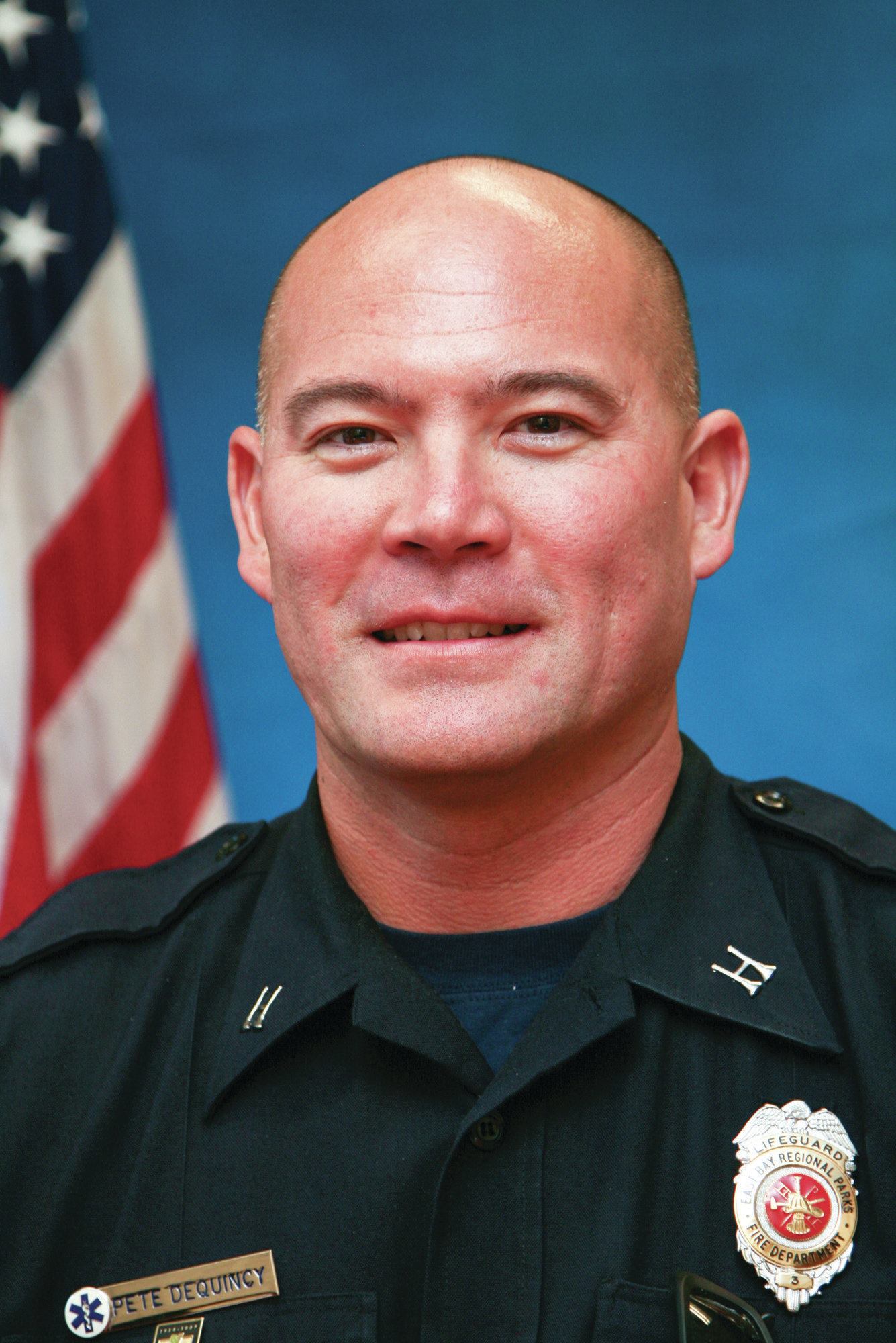
Pete DeQuincy is the aquatics manager at East Bay Regional Park District in Oakland, Calif. He is an American Red Cross instructor trainer in water safety, lifeguarding, and emergency medical response.