
Commercial aquatics facilities across North America are under increasing pressure to do more with less. Aging infrastructure, tighter renovation timelines, rising maintenance costs, and heightened expectations around safety and performance leave owners and operators rethinking how they approach renovation, looking beyond traditional surface and waterproofing products.
Originally introduced as an alternative finish for pool interiors, reinforced PVC membranes now also are specified for splash pads, aquatics renovations, decks, locker rooms, and indoor wet zones.
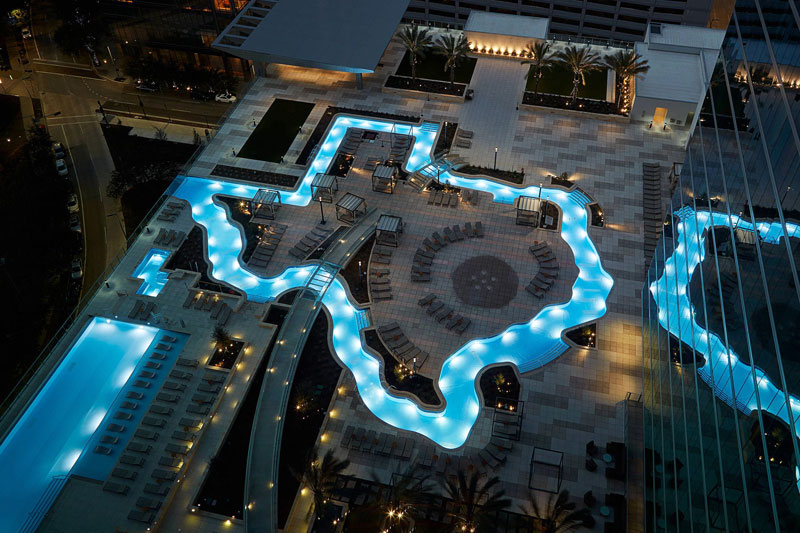
A recent example of this versatility can be found at the Marriott Marquis in Houston, where Natare Pools of Indianapolis completed a complex rooftop aquatics installation. Reinforced PVC membrane was selected to line multiple features within the facility, including an infinity-edge pool and a unique lazy river that forms an outline of the state of Texas. Given that the entire aquatics complex is located on the hotel’s roof, waterproofing performance was a critical concern for protecting the structure below. The engineers chose reinforced PVC membrane, in large part for its watertight properties, in addition to its durability and appearance.
One of the more notable aspects of the project was the nonlinear geometry of the lazy river and surrounding features.
To accommodate the complex shapes, each segment of the stainless-steel skirt was custom manufactured and installed by Natare, then carefully aligned and welded to ensure a continuous, watertight seal. This was done to provide the necessary structural support for the reinforced PVC membrane while allowing for seamless integration across the lazy river, infinity pool, and splash pad.
The success of the project underscored the importance of collaboration among system design, materials, and installation expertise, says Joshua Albertson, sales manager at Natare.
The installation demonstrates how reinforced PVC membranes can help commercial aquatics facilities overcome design complexity, structural constraints, and long-term maintenance concerns while delivering reliable waterproofing and design flexibility in even the most demanding environments.
Splash pads and interactive water play environments
Splash pads and interactive water play areas present a unique set of performance challenges. These zero-depth environments experience constant exposure to water, heavy foot traffic, UV radiation, temperature fluctuations and, in many regions, freeze–thaw cycles — all of which impose substantial wear and tear on finish materials.
Reinforced PVC membranes offer a watertight solution that can eliminate many common failure points, such as cracking or delamination. Installed as a fully welded system, the membrane works to prevent water from infiltrating the concrete slab below, helping to protect the structure from moisture-related deterioration. This is especially important in splash pads, where water is continuously sprayed, drained, and recycled across the surface.
Courtesy Natare
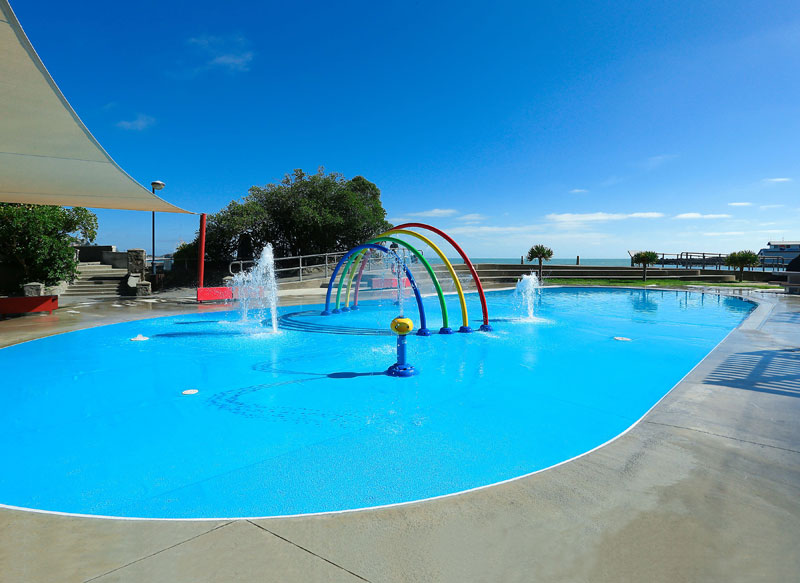
In the case of the Scarborough Splash Pad in Christchurch, New Zealand, an older splash pad (or paddling pool as they call them in New Zealand) had been damaged by an earthquake and needed replacement. The new splash pad was constructed using stainless steel walls and a reinforced PVC membrane, chosen for its slipresistant qualities and ability to shift with ground movement, among other reasons. In this particular case, it offers a zero-depth splash pad area that extends into a slightly deeper “padding pool” all covered with the reinforced PVC membrane.
Design flexibility also plays an important role in splash pad projects. Membranes are available in a wide range of colors, allowing designers to clearly define play zones, circulation paths, and safety areas while maintaining a seamless, easy-to-clean surface.
In addition, installation timelines are often shorter than those associated with traditional systems, making reinforced PVC well suited for municipal splash pads and park installations with limited seasonal construction windows.
Aquatics facility renovations: Pool interiors
Renovation represents one of the fastest-growing applications for reinforced PVC membranes in commercial aquatics. Many public and institutional pools built decades ago are now dealing with cracked plaster, failing paint systems, tile delamination, and chronic leakage.
Reinforced PVC membranes are particularly well suited for renovation because they can be installed as an overlay system. In many cases, the membrane is applied directly over existing concrete or tile substrates after appropriate surface preparation. This significantly reduces demolition work, shortens project schedules, and minimizes disruption to facility operations.
Reinforced PVC can bridge cracks and accommodate substrate movement. The internal reinforcement layer allows the membrane to absorb minor structural shifts without compromising watertightness, even when underlying structures show signs of age.
And, once again, shorter, more predictable timelines amount to less disruption.
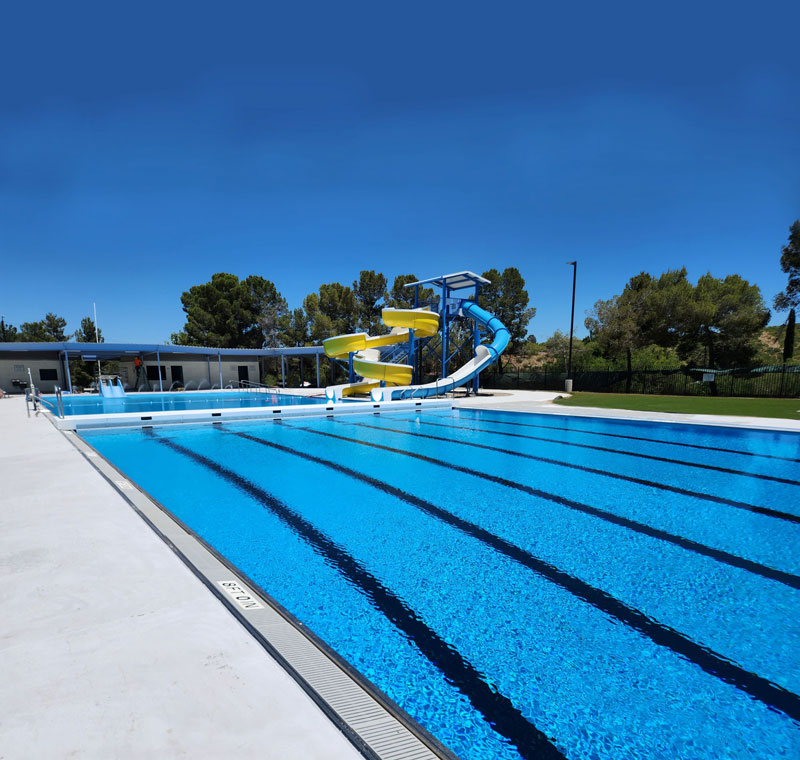
The City of Globe, Ariz. community pool remained empty for nearly 10 years. It suffered from continuous water loss, structural failure, and a complete breakdown of its mechanical systems. The concrete gutters had failed, large sections of the floor were missing, the perimeter piping system had collapsed, and the facility lacked a functioning filtration system. Before closure, the pool required excessive refilling and constant chemical adjustments to stay open. Even then, the structural issues made operation unsustainable.
Natare Pools installed a reinforced PVC membrane system that created a fully watertight basin, despite its previous catastrophic condition. The membrane restored the pool’s integrity and significantly lowered its long-term operational and environmental impact.
“We worked with the city and also added a new splash pad using reinforced PVC membrane,” Albertson says. “The City of Globe Community Center Pool has now been revitalized to its fullest potential and will continue to welcome families and competitive swim teams for years to come.”
From a lifecycle perspective, reinforced PVC membranes are often accompanied by water-tightness warranties of up to 20 years, depending on the product and application.
Decking, locker rooms, and indoor wet areas
The use of reinforced PVC membranes is also expanding beyond pool vessels into surrounding aquatics spaces, including decks, locker rooms, showers, and transition zones. These areas are frequently exposed to water, chemicals, and aggressive cleaning regimens, making waterproofing and slip resistance critical considerations. Slip resistance is a key here, as well.
In these applications, reinforced PVC acts as both a waterproofing layer and a finished surface. This reduces the risk of water migrating under floors or into adjacent spaces — an issue that commonly leads to costly repairs.
Chemical resistance is another important benefit. Reinforced PVC membranes are designed to withstand exposure to chlorinated runoff, cleaning agents, and disinfectants commonly used in commercial aquatics facilities. Their non-porous surface simplifies maintenance routines and supports hygienic conditions by limiting the potential for microbial growth. In fact, cleaning reinforced PVC can be done quickly and effectively using a power washer.
A holistic approach to commercial aquatics
As commercial aquatics facilities continue to modernize, reinforced PVC membranes are increasingly recognized as more than a pool finish. Their watertight performance, slipresistant safety, durability, efficient installation, and color selection makes for versatility across splash pads, renovation projects, decks, and interior wet spaces.