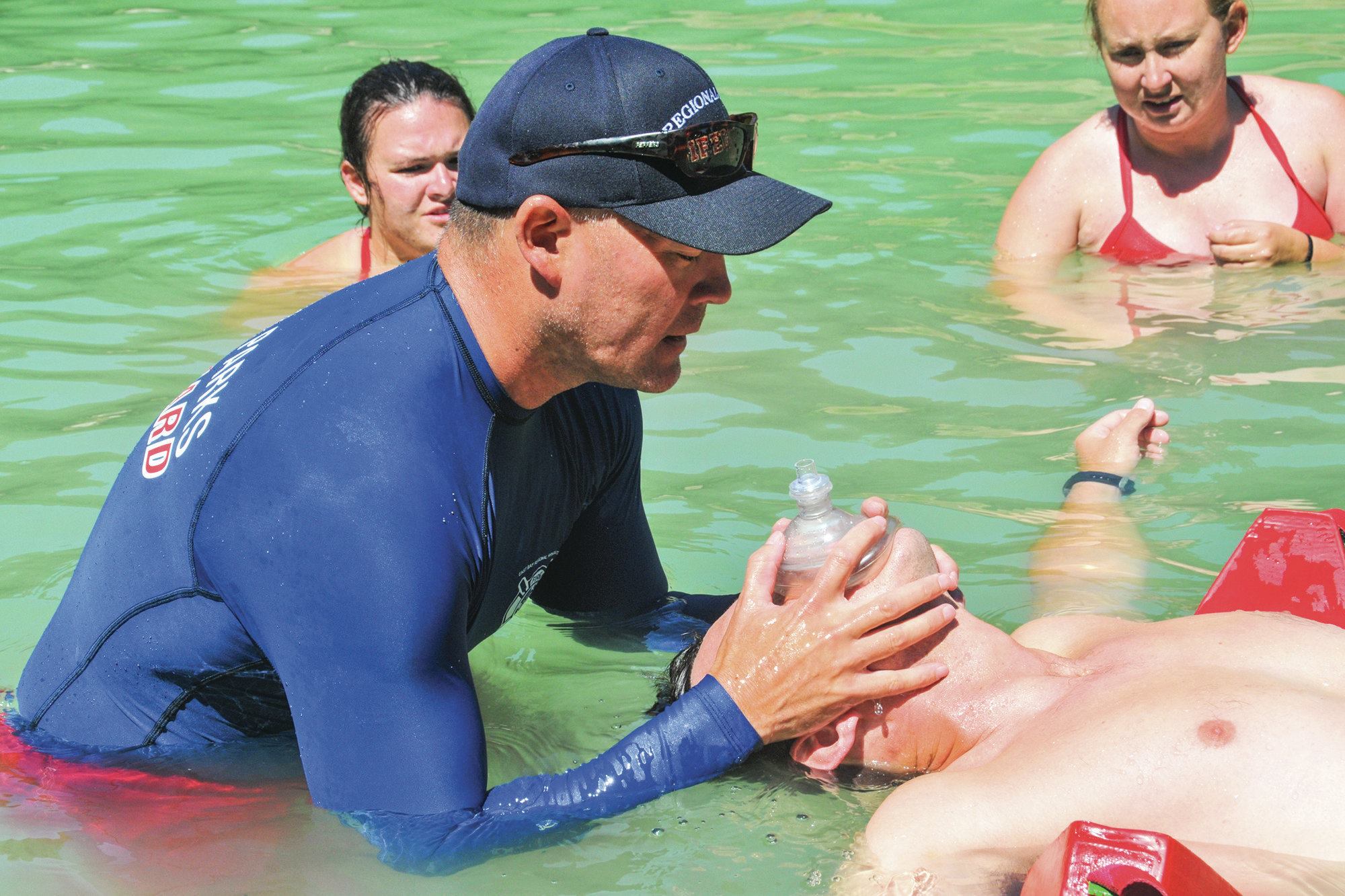
For most visitors, a lifeguard is only seen up in the tower conducting surveillance, making prevents, and sometimes making the rescue.
But lifeguards also do first aid — a lot of first aid. More first aid than making rescues. Most first aid is classified as “walk-in,” where the visitor approaches the First Aid Station and asks for assistance. The care provided could include cleaning a scrape followed with a bandage, some Sting Kill for a bite or sting, irrigation to the eyes for sunscreen or sand, or the use of tweezers for a splinter.
But the other type of first aid is classified as “respond to,” where the visitor is unable to walk to the First Aid Station to receive care. Lifeguards will have to assess and provide care for a wide variety of injuries and medical conditions. This could include heat- or cold-related emergencies, diabetic emergencies, breathing difficulties, severe abdominal pain and vomiting, fainting, anaphylaxis, stroke, opioid overdose, poisoning, a sting or bite — and the list goes on.
Providing first-aid care involves three fundamental skills:
Recognize when help is needed. The lifeguard must know when they should step in and provide care to the visitor, whether the care is minor or major.
Identify the problem. After recognizing the need to act, the lifeguard should assess what’s ailing the visitor.
Provide the appropriate care. This could be minor, immediate care to an injury or illness along with treating for potential shock; ongoing care; or emergency intervention such as performing CPR, controlling severe bleeding, clearing an obstructed airway, providing rescue breaths, and engaging the help of Fire, EMS and other outside resources.
Let’s review drills that support these fundamentals:
JUST A FACE DRILL: This involves four to seven lifeguards – one assessor and three to six participants. Each participant will take on one facial characteristic demonstrating their physical status: Feeling pain, ill, healthy, or unresponsive. The assessor can only look at the participant’s face to determine their status. If needed, the assessor can ask each participant one question about their physical status, which can only be answered with “Yes” or “No.”
OBJECTIVE: The assessor must correctly identify the physical status of all participants.
TIMING GOAL: 60 seconds.
Variations to make the drill more challenging:
– Increase the number of participants to be assessed
– Reduce the time to 30 seconds
– The assessor can only ask one participant one question
– Remove the assessor’s ability to ask questions
FREEZE FRAME DRILL: This uses the same number of lifeguards – one as the assessor, three to six as participants. Each participant will freeze in a pose that demonstrates their level of crisis: Walk-in first aid or need to respond; emergency, or no emergency. The assessor can only look at a participant’s pose to determine their status. If needed, the assessor can ask each participant one question regarding their level of crisis; the participant can only respond “Yes” or “No.”
OBJECTIVE: The assessor must correctly identify the level of crisis for all participants.
TIMING GOAL: 60 seconds.
Variations to make the drill more challenging:
– Increase the number of participants to be assessed
– Reduce the time to 30 seconds
– The assessor can only ask one participant one question
– The assessor cannot ask any questions
– Combine with Just a Face drill (above)
ONE ACTION DRILL: Again, four to seven lifeguards are utilized — one will be the assessor while the remaining act as participants. Each participant will take pose and take on one movement that highlights their injury or illness: Diabetic emergency, bee sting, stroke, heat-related illness, cold-related illness, difficulty breathing, obstructed airway, foreign material in eyes, broken bone, etc. The assessor must determine the participant’s injury or illness. If needed, the assessor can ask one question to each participant regarding their injury or illness, but the participant can only respond with an answer of “Yes” or “No.”
OBJECTIVE: Correctly identify the injuries and illnesses of all participants.
TIMING GOAL: 60 seconds.
Variations to make the drill more challenging:
– Increase the number of participants to assess
– Reduce the time to 30 seconds
– The assessor can only ask one participant one question
– The assessor cannot ask any questions
– Add another team member to support the movement
– Combine with Just a Face and Freeze Frame drills above
TREATMENT SEQUENCE: Divide into two teams. Each team will provide one pair of lifeguards who will act out the treatment for the injury or illness. The actors must use hand gestures and body movement to act out the proper sequence of treatment for the injury or illness. The opposing team tries to identify whether the actors missed a step or misplaced a step in the treatment. Three points are awarded to the team that performs the sequence correctly. One point is given if the opposing team identifies a missing step or if treatment steps are out of sequence (No more than three points can be obtained per sequence.) One participant will be designated as a judge to make the final decision on contentious points. The lifeguard manual will be used as reference for the judge.
OBJECTIVE: Each team must perform the correct sequence of a treatment for an injury or illness. The team with the most points, wins.
TIMING GOAL: 3 minutes per turn.
TREATMENT CHARADES: Divide into two teams. Each team will provide one pair of lifeguards who will act out the treatment for the injury or illness. The actors must use hand gestures and body movement to act out the treatment for the injury or illness. The actor’s team will try to guess the injury or illness. A point will be awarded for each correct answer.
OBJECTIVE: Each team must correctly guess the injury or illness that corresponds to the treatment being acted out. The team with the most points, wins.
TIMING GOAL: 3 minutes per turn.
Variations to make Charades more challenging:
– Speed Rounds, where the first team to get four out of five answers correct, wins the round.
– Reverse Charades, where the team performs the treatment, and one person does the guessing
MISTAKES TO LOOK FOR
As the trainer, your critical eye is needed so participants don’t make mistakes that could delay or compromise care. Here are some errors you might see:
– Lifeguards rushing through the drills
– Lifeguards shying away from participating in the drills
– Lifeguards don’t provide the full treatment
– Lifeguards don’t reference to the lifeguard manual or practice above their level of training
As the trainer, remind your team that first aid is important. Remind them of the value in doing training on minor and mid-level first-aid emergencies.
Good luck and keep training.