Recently, I had the opportunity to be a part of a two-and-a-half-year construction project that involved designing, planning, and opening an approximately $70 million recreation and aquatic center facility, the first of its kind in the municipality I work for.
In my role as aquatics supervisor, I held responsibility for informing the design, developing a program plan and budget, and building a team to open the aquatics portion of the center in March of 2025. The project challenged me in many ways both professionally and personally, and I am very grateful for the experience this opportunity provided.
This article will focus on the design and construction of our new aquatic facility and what steps we took to ensure that the final product met the needs of our community.
Project roadmap
Building and opening a new aquatics facility requires a huge investment for a municipality. It is a long process that involves many different phases, including conducting feasibility studies, collecting public input, finding funding, recruiting a contractor and architect. Then come the design, permitting, construction, and commissioning.
In the development of our facility, the timeline of design, construction, permitting, and commissioning took place over two and a half years, beginning in 2022 and ending in 2025. Before I joined the team in the design phase, multiple years’ worth of feasibility studies, public input, and funding decisions had taken place
Each center will be different, but understanding the construction phases can help ensure that the project moves at a smooth pace. Over the long term, this knowledge also will avoid costly changes down the road.
The right people at the table
Every construction project, whether a new build or renovation, has a team that works collaboratively to bring that project from concept to completion.
That team usually includes multiple municipal departments, along with the contractor, architect, design consultant, project manager, and sometimes other specialties. For new construction, such as the project I participated in, it is common practice to start design and construction at the highest levels of the municipality involving department directors and municipal leadership.
Too often, those who will open and operate the future facility are not brought to the table until much later in the project.
In the case of our new facility, department leadership recognized that they did not have professional experience overseeing aquatics programs and services, so they felt it important to recruit a professional with that background to weigh in on important design and operational questions that come up. As the staff member ultimately responsible for opening and operating our facility, I am eternally grateful that I was included early, because my input helped us achieve a fantastic final product.
From the very beginning of the design process, I could provide input on important decisions such as filter, pump, and chemical systems, pool layout and design, and amenities. The process was extremely collaborative. We started by looking at the overall pool design and layout. Working with our design consultant, we were able to develop a pool design that made sense for the types of programs that we wanted to provide. The design consultants took our feedback, then gave us design options that we could workshop until we came to a final decision as a team.
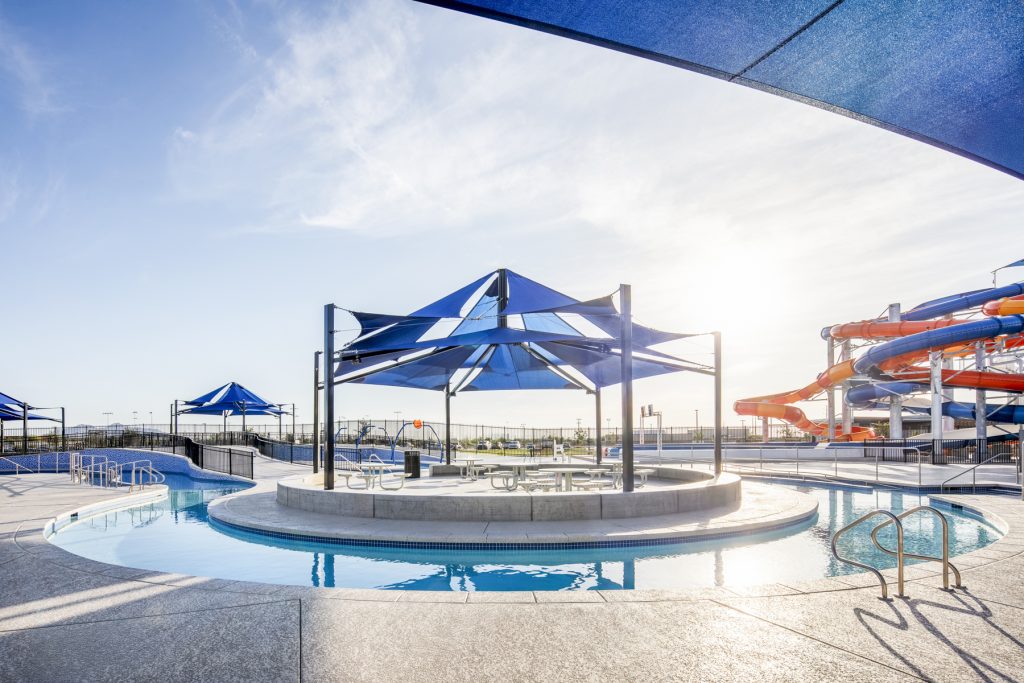
For example, the team determined early in the design process that a lazy river was a key amenity that the town wanted. River features are extremely popular for the public, however they create a challenge from a lifeguard coverage perspective: The shape can naturally create blind spots, so they often require heavier staffing levels than standard pools. I was able to work with the design consultants and our internal team to develop a river that had long, winding bends instead of smaller, sharper curves. This also leant itself to having a large island in the river that provided an opportunity to add reservable ramada spaces, something that we use to generate additional revenue. Without someone at the table who understands lifeguard zones and coverage, the design likely would have gone in a different direction and required more staff, and consequently a larger budget to operate.
Including an aquatics expert in the planning also helped inform the shape, size, and function of our leisure pool. This body of water is most heavily used during recreational swim times, because it has an activity tower and has a maximum depth of 4.5 feet. It also is heavily used for learn-to-swim programming and water exercise year-round. During the design process, we wanted to ensure that the pool was flexible enough to meet the diverse needs of our various programs. To us, that looked like gradual depth changes, multiple walls with sitting areas for lessons, and large stair entries to facilitate both access and lesson programming.
Accessibility also made up a big component of our design. We wanted to ensure that people of all abilities could enjoy the pool, and that is reflected in our design. Outside of the standard ADA lifts required by code, we incorporated a beach entry into our family pool and wheelchair ramp access to our lazy river.
My advice to any organizations that see building a new aquatics center in the future is to ensure that you seek the input of someone with experience operating these facilities and programs as early as possible in the process. With the right minds working collaboratively, you can plan a facility that meets the needs of the community and is functional from an operational standpoint.
Designing and building a new facility is a daunting task that represents a huge investment. It is vital to ensure that you set your organization up for success with the final product.
If you are considering building a new facility, I encourage you to have qualified, aquatic professionals at the table as early as possible in the design and construction process, and that you establish and cultivate a professional network that you can rely on to fill in any gaps in knowledge or experience. By taking these steps you can help to ensure that your final product has a successful opening and ensures that the new facility meets the goals and expectations of the communities you serve.
Sidebar:
Use your Network
One of the most powerful tools in an aquatics professional’s tool belt is their ability to establish a professional network. Whether it be local, regional, national, or even international, these are people on whom you can rely to help answer questions and bounce ideas off of, and they’re a key to your facility’s success.
I relied heavily on my professional network, gained through local groups and national organizations such as the Association of Aquatic Professionals (AOAP), to bring this facility to life. This was the first time that I have been involved in a major construction project, and I had plenty of internal doubt that I had enough knowledge to succeed in this role. My professional network taught me a lot about what to expect and how to set our team up for long-term success.
During our pump-room design, for example, I was asked if I wanted sand or regenerative-media filtration systems. Regenerative media filters are relatively new on the market, and I have had no practical experience with them. Through my network, I could chat with users of regenerative filtration around the country to learn their practical experience with these systems, as well as discuss options with other professionals who I trust to provide me with unbiased feedback. From these conversations, I was able to choose a direction for our facility that made sense.
Most impactfully, my network provided opportunities for me to visit other local facilities to see firsthand features that we wanted to incorporate. By meeting with these other teams and discussing the successes and challenges of their pool designs, we could make more informed decisions about what to include in our design. One of the most common points of feedback we heard was the importance of deck shade (Arizona summers are brutal!) and dedicated equipment storage. Both of these items were weighed heavily in our design and we were able to incorporate a lot of shade and storage into our final product.
We like to jokingly say that our facility is a collection of the best of the best from other facilities, but to a certain extent that is true. Using our local and national networks expanded our knowledge and gave us the chance to build a great facility that incorporated the lessons we learned from other professionals who have gone through similar experiences.
Joey LaNeve is aquatics supervisor for the Town of Queen Creek, Ariz. He also serves as president of the Association of Aquatic Professionals.