Airway management is a fundamental lifeguard skill that all rescuers should practice frequently.
Here, I present two lean in-services to address this issue. These 15-minute training sessions focus on just one or two areas of a rescue rather than a full scenario. Improving on small, critical aspects of a lifesaving skill through rapid repetition helps develop your lifeguards’ ability to respond, rescue, and provide care in a quick, efficient, and synchronized manner.
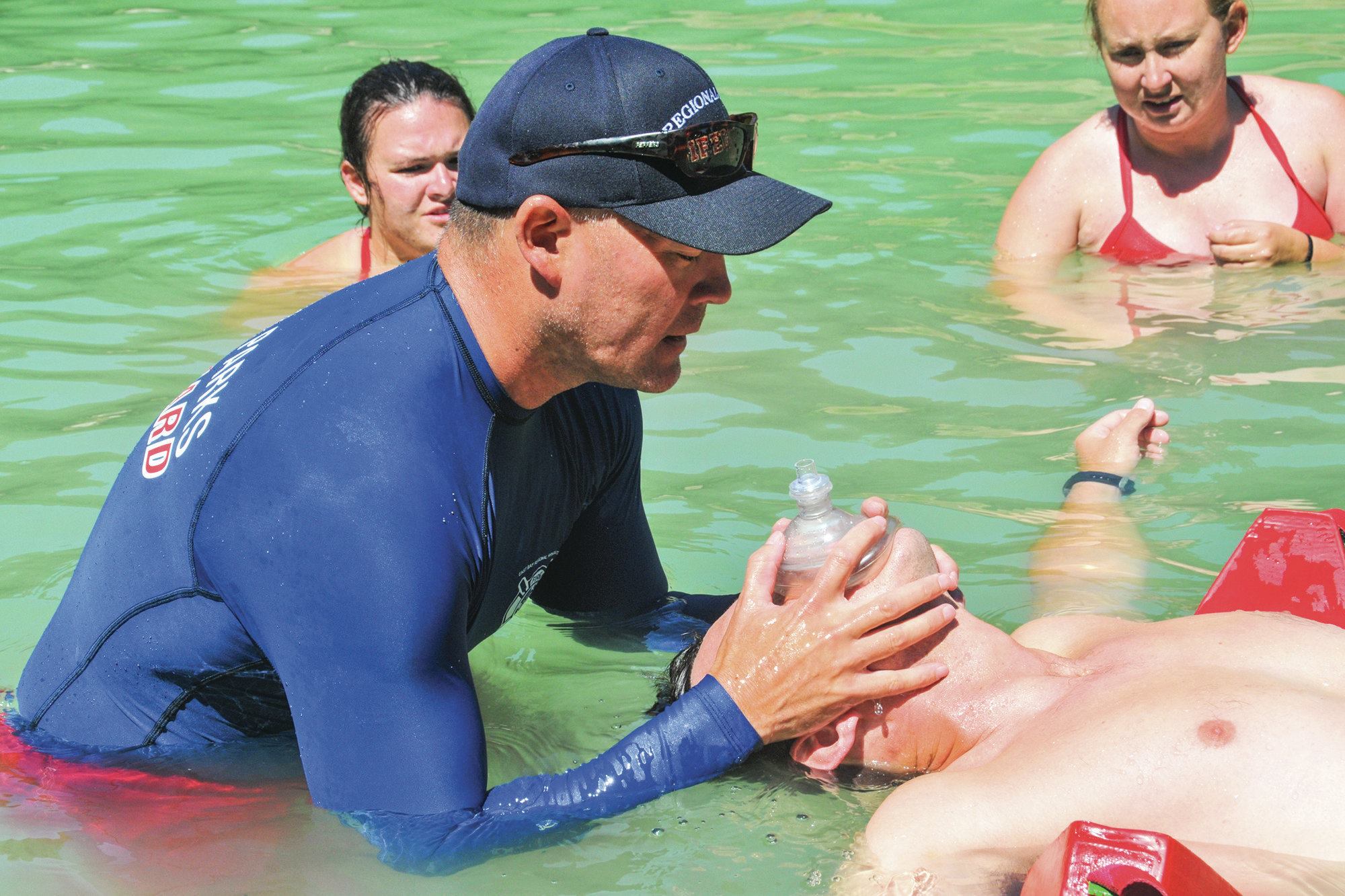
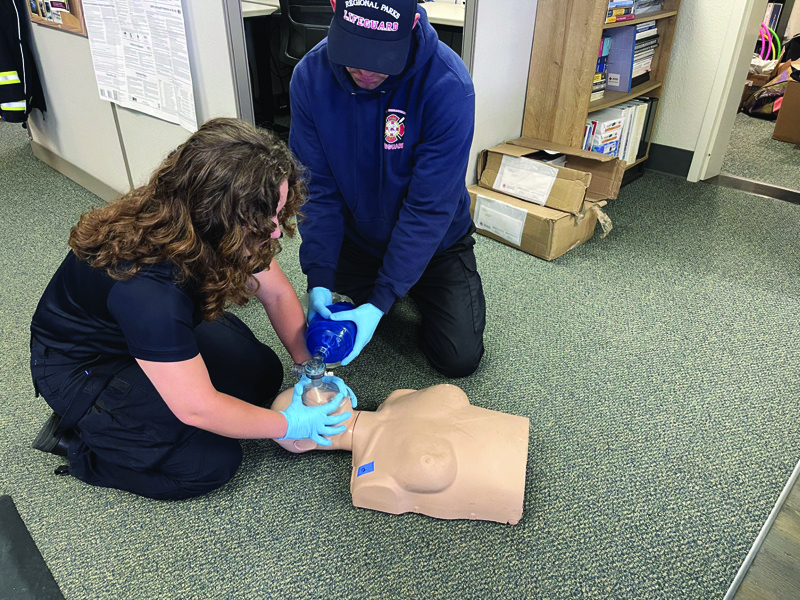
The land in-service below focuses on developing proficiency in rescue breathing with the use of a resuscitation mask. Go to aquaticsintl.com for a session on rescue breathing using a Bag Valve Mask (BVM). The water in-service focuses on speed of contact of the Guest in Distress (GID), speed of getting the GID to the surface, teamwork, and proper placement of a GID onto the rescue tube.
First, I’ll provide a quick review of how to structure lean in-service sessions for maximum results.
| SUMMARY OF THE 15-MINUTE IN-SERVICE FRAMEWORK
15-Minute In-Service: Topic |
||
| Introduction | 1 minute | |
| Skill No. 1 | 3 minutes | Benchmark to be achieved |
| Skill No. 2 | 3 minutes | Benchmark to be achieved |
| Skill No. 3 | 3 minutes | Benchmark to be achieved |
| Skill No. 4 | 3 minutes | Benchmark to be achieved |
| Closing | 2 minutes | |
Introduction
The introduction should provide the set-up and explanation of the first skill/activity.
Skills
Skill blocks should focus on improving on one specific skill.
Closing
Allows the trainer to provide feedback to lifeguards regarding their skills, the trainers’ goal, and how the in-service aligns with overall job duties.
Benchmarks
Benchmarks outline what the trainer hopes to achieve within each skill block. This can include the acquisition and/or development of a specific skill or the achievement of a timing goal.
The lean in-service allows opportunities for the trainer to identify gaps or rough spots that might require a new additional training block or a repeat of an existing block (skill refresher/polish).
THINGS TO CONSIDER AS THE TRAINER
As the trainer, your critical eye is necessary to ensure that your lifeguards are meeting your benchmarks. Keep in mind the following so your in-service is successful:
Lifeguards should be proficient at all skills before in-service.
Be mindful of your time management; it’s easy to go over the time limit.
It’s okay to repeat a skill block if necessary.
Less talk, more interaction. Keep your lifeguards engaged.
If you have to explain something, perform a visual demonstration if possible.
| LAND IN-SERVICE | ||
| 15-Minute In-Service: Ventilations with a Resuscitation Mask | ||
| Introduction: How to ventilate with a resuscitation mask on an adult |
1 minute | Give quick explanation and demonstrate the rescuer’s role in rescue breathing |
| Skill No. 1 Solo rescuer provides rescue breaths
2-4 rescuer group with 1 rescuer |
3 minutes
Each rescuer provides 3-5 rescue breaths to the manikin Repeat the skill, strive for three rounds if time allows |
Benchmark: Rescuers can provide effective rescue breaths using the Triple Airway Maneuver |
| Skill No. 2 Maintaining an open airway when providing rescue breaths, during the transition between rescuers. 2-4 rescuer group with 1 rescuer providing care on an adult manikin, then transitions to new rescuer |
3 minutes
6 transitions minimum, striving for 12 transitions or more: Each rescuer should provide 2-3 rescue breaths before transitioning care |
Benchmark: Rescuers can effectively maintain an open airway and effectively provide rescue breaths while they transition care from one rescuer to another using the Triple Airway Maneuver.
Provide uninterrupted care during the transitions. |
| Skill No. 3 Donning gloves before taking over the role of the primary rescuer providing rescue breathing. Maintaining an open airway when providing rescue breaths, during the transition between rescuers. 2-4 rescuer group with 1 rescuer providing care on an adult manikin, then transitions to new rescuer |
3 minutes
6 transition minimum, striving for Each rescuer should provide 2-3 rescue breaths before transitioning care |
Benchmark: Rescuers can successfully don gloves before taking over as the primary rescuer.
Maintain an open airway while providing |
| Skill No. 4 Pulling gloves and resuscitation mask from fanny pack, then donning gloves before taking over the role of the primary rescuer providing rescue breathing. Maintaining an open airway when providing rescue breaths, during the transition between rescuers 2-4 rescuer group with 1 rescuer providing care on an adult manikin, then transitions to new rescuer |
3 Minutes
6 transition minimum, striving for 12 transition or more: Each rescuer should provide |
Benchmark: Rescuers can pull gloves and resuscitation mask from fanny pack and successfully don gloves before taking over as the primary rescuer. Maintain an open airway while providing |
| Closing | 2 minutes | Provide feedback and remind lifeguards how the training aligns with the larger duties and tasks. |
| WATER IN-SERVICE | ||
| 15-Minute In-Service: Passive Guest-in-Distress (GID) Submerged in Shallow Water | ||
| Introduction: Rescuing a passive victim submerged, face-down in shallow water |
1 minute | Give quick explanation and demonstrate in bringing the submerged GID to the surface with both airways above water. Demo of GID placement on the rescue tube to maintain an open airway |
| Skill No. 1 Rescue the Guest in Distress (GID), 15 feet away, face-down, submerged. Lifeguard starts at edge of pool, in water or Enters the water safely and quickly. 1-to-1 ratio (Lifeguard/GID) |
3 minutes
3 reps minimum, striving for 12 reps or more: 1 rep at 12 seconds, then decrease by 1-2 seconds until GID is pulled to the surface in 4 seconds 3 reps at 4 seconds |
Benchmark: The rescuer can successfully bring the GID to the surface with both airways above the water.
Can be done with or without a rescue tube. |
| Skill No. 2 Team rescue the Guest in Distress (GID), 15 feet away, face-down, submerged.
Lifeguards starts at edge of pool, in water or standing on deck. Rescue team enters the water safely and quickly. 2-to-1 ratio (Lifeguard/GID) |
3 minutes
3 reps minimum, striving for 12 reps or more: 1 rep at 10 seconds, then decrease by 1-2 seconds until GID is pulled to the surface in 4 seconds 3 reps at 4 seconds |
Benchmark: Rescue team coordinates and works together on quickly and safely bringing the GID to the surface with both airways above the water.
Can be done with or without a rescue tube. |
| Skill No. 3 Team rescue the Guest in Distress (GID), 15 feet away, face-down, submerged. GID is brought to the surface and secured on a rescue tube, face-up.
Lifeguards starts at edge of pool, in water or standing on deck. Rescue team enters the water safely and quickly. 2-to-1 ratio (Lifeguard/GID) |
3 minutes
3 reps minimum, striving for 9 reps or more: 1 rep at 10 seconds, then decrease by 1-2 seconds each time until making the rescue with good placement of the GID on rescue tube in 6 seconds 3 reps at 6 seconds |
Benchmark: Rescue team coordinates and works together on quickly and safely bringing the GID to the surface with both airways above the water. GID is securely placed on rescue tube, face-up. |
| Skill No. 4 Solo rescue the Guest in Distress (GID), 15 feet away, face-down, submerged. GID is brought to the surface and secured to the rescue tube, face-up.
Lifeguard starts at edge of pool, in water or Rescuer enters the water safely and quickly. 1-to-1 ratio (Lifeguard/GID) |
3 minutes
3 reps minimum, striving for 12 reps or more: 1 rep at 10 seconds, then decrease by 1-2 seconds until GID is pulled to the surface in 4 seconds 3 reps at 4 seconds |
Benchmark: The rescuer can successfully bring the GID to the surface with both airways above the water. GID is secured to the rescue tube.
|
| Closing | 2 minutes | Provide feedback and remind lifeguards how the training aligns with the larger duties and tasks. |
COMMON MISTAKES SEEN DURING IN-SERVICE
Improper placement of the resuscitation mask or BVM mask.
Ineffective seal of the resuscitation mask or BVM mask.
Ineffective rescue breaths don’t make the manikin’s chest rise
Improper placement of the GID on the rescue tube that supports both airways to be above the water
Remember bringing lifeguards together for in-service take a lot of time and energy, and it can be pricey. Maximize your interaction time with them and reap the benefits.
Good luck and keep training.