Saving a person who is actively drowning is one of the core skills all lifeguards know. When a life-threatening situation arises, the lifeguard must respond quickly to prevent a potentially deadly outcome.
These scenarios also provide the most drama and gratification. With active water rescues, the person may very well be saved and walk away unscathed. And they will thank you profusely. In practice, they are the most interesting because of the drama. That applies to even the enacted ones performed for training purposes.
But a successful active water rescue depends on certain building-block skills. Up to this point, I have provided short 15-minute in-service sessions, which I call Lean In-service, on CPR, airway management, and other basic skills that combine to make a successful rescue.
Here are two Lean In-service sessions that focus on developing proficiency and speed in responding to an active drowning guest in distress (GID).
Brief but impactful
Lean In-services pack a lot into a little time. That is why
I have been promoting them this year.
But it is not just the brevity that makes them so effective. By keeping them short, we are forced to target a very specific skill. We can concentrate on smaller components and then build them up, rather than training on a skill that involves multiple components and therefore multiple opportunities to fail.
Any trainer can develop a Lean In-service for their lifeguards. Here is a review of the structure for these drills.
Summary of the 15-minute in-service framework
| 15-minute LEAN IN-SERVICE: Topic | ||
| Introduction | 1 minute | |
| Skill #1 | 3 minutes | Benchmark to be achieved |
| Skill #2 | 3 minutes | Benchmark to be achieved |
| Skill #3 | 3 minutes | Benchmark to be achieved |
| Skill #4 | 3 minutes | Benchmark to be achieved |
| Closing | 2 minutes | |
Introduction
The introduction should provide the setup and explanation of the first skill/activity.
Skills
Each skill block should focus on improving one specific skill.
Closing
This time allows the trainer to provide feedback to lifeguards on their skills, the trainer’s goals, and how the in-service aligns with overall job duties.
Benchmarks
Benchmarks outline what the trainer hopes to achieve within the skill block. This can include a specific skill to be acquired or a timing goal to be achieved.
LEAN IN-SERVICE #1
| 15-Minute LEAN IN-SERVICE: Active Rescue of Guest in Distress (GID) in Mid Depth | ||
| Introduction: How to rescue from the front and rear of the GID | 1 minute | Give a quick explanation and demonstrate the contact positions to the GID. |
| Skill #1: Rescue approaches
One person will be the GID designated at point “A,” while the remaining lifeguards will make the rescue one at a time. (1–6 rescuers for this drill) |
3 minutes
Each rescuer will start from the side and swim toward the GID at point “A.” The goal is to improve speed and form in the following: modified front crawl with the rescue tube, modified breaststroke with the rescue tube, and swimming with the rescue tube trailing behind. Repeat the skill, striving for nine approaches if time allows. |
Benchmark: Rescuers should focus on improving speed while swimming with the rescue tube, continually reducing the time spent separated from the tube. |
| Skill #2: Repositioning the rescue tube
Rescuers will start on one side of the pool and swim to the other. |
3 minutes
Rescuers swim with the rescue tube trailing. Midway through, they reposition the rescue tube and continue in either modified front crawl or modified breaststroke. |
Benchmark: Rescuers should focus on improving speed and proficiency when repositioning the rescue tube. |
| Skill #3: Front rescues with a rescue tube
One lifeguard will be the GID, while the remaining make the rescue one at a time. (1–6 rescuers for this drill) |
3 minutes
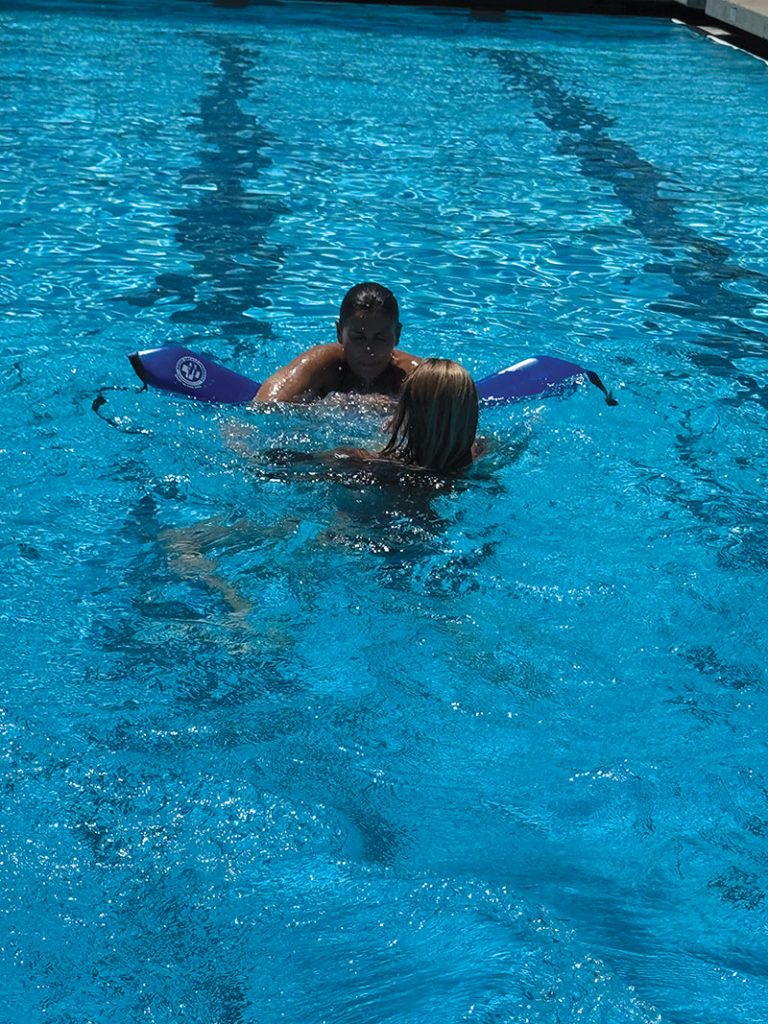
Each rescuer starts from the side, enters the water quickly and safely, makes contact with the GID, secures the GID to the rescue tube, then moves to the side to allow the next rescuer to make the rescue. Note: GID will remain in the water for the next rescuer. Repeat the skill, striving for nine rescues |
Benchmark: Rescuers should make safe, quick entries and never lose sight of the GID. Additionally, keep arms extended and locked to prevent the GID from grabbing the rescuer instead of the tube. |
| Skill #4: Rear rescues with a rescue tube
One person will be the GID, while the remaining make the rescue one at a time. (1–6 rescuers for this drill) |
3 minutes
Each rescuer starts from the side, enters the water quickly and safely, makes contact with the GID, secures the GID to the rescue tube, then moves to the side to allow the next lifeguard to make the rescue. Note: GID will remain in the water for the next rescuer. Repeat the skill, striving for nine rescues if time allows. |
Benchmark: Rescuers should make safe and quick entries, never losing sight of the GID. Make contact with the GID from behind, maintain a secure hold, and keep your head turned to the side so the GID cannot grab or injure the rescuer. |
| Closing | 2 minutes | Provide feedback and remind lifeguards how the training aligns with the larger duties and tasks. |
LEAN IN-SERVICE #2
| 15-Minute LEAN IN-SERVICE: Multi-Rescuer Response, Multi-adult and/or Child Guests in Distress (GIDs) | ||
| Introduction: How rescuers will work together to rescue an active Guest in Distress (GID). | 1 minute | Give a quick explanation and demonstrate the rescuers’ roles. |
| Skill #1: Multi-lifeguard rescue of an active GID, simultaneous response.
Three-person rescuer groups, with 2 rescuers initiating the response to the remaining rescuer, who acts as the GID. Rescue tubes needed. |
3 minutes
Rescuers will respond from two different points to rescue the GID. One rescuer should approach from the front of the GID, and one from the back. After performing the skill, rescuers switch approaches. Repeat the skill to improve technique, speed, and coordination. Repeat the skill, aiming for 6 rounds |
Benchmark: Rescuers should focus on speed, timing, and communication with one another while securing the GID. |
| Skill #2: Multi-rescuer response to an active GID, staggered response (5–10 seconds).
Three-person rescuer groups, with 2 rescuers initiating the response to the remaining lifeguard, who acts as the GID. Rescue tubes are needed. |
3 minutes
Rescuers will respond from two different points to rescue 1 GID. One rescuer should approach from the front and the other from the back of the GID. After performing the skill, rescuers switch approaches. One will leave 5–10 seconds ahead of the second. Repeat the skill to improve technique, speed, and coordination. Strive for 6 rounds, |
Benchmark: Rescuers should focus on speed, timing, and communication with one another to secure the GID simultaneously. If not simultaneously, the secondary rescuer should support the one who makes first contact with the GID. |
| Skill #3: Multiple lifeguards rescue two active GIDs, simultaneous response.
Four-person rescuer groups, with 2 rescuers initiating the response, and the remaining |
3 minutes
Lifeguards will respond to rescue 2 GIDs. Rescuers should approach each GID from the rear, if possible, to secure each of them. Repeat the skill to improve technique, speed, and coordination. In repeating the skill, strive for 6 rounds |
Benchmark: Rescuers should focus on speed, timing, and communication while securing the GIDs. |
| Skill #4: Three lifeguards respond to rescue two active GIDs simultaneously.
Five-person rescuer groups, with 3 initiating the response and the remaining 2 acting as the GIDs. Rescue tubes needed. |
3 minutes
Lifeguards will respond to rescue 2 GIDs. Rescuers should approach the GIDs from the rear, if possible, to secure each of them. Repeat the skill to improve technique, speed, and coordination. Repeat the skill, striving for 6 rounds |
Benchmark: Rescuers should focus on speed, timing, and communication while securing the GIDs. |
| Closing | 2 minutes | Provide feedback and remind lifeguards how the training aligns with larger duties and tasks. |
The Lean In-service provides opportunities for the trainer to identify gaps or rough spots that might require an additional training block or a repeat of an existing block (skill refresher/polish).
Things to consider as the trainer
As the trainer, your critical eye is essential to ensure the lifeguards meet the benchmarks. Keep in mind the following to help ensure a successful in-service:
- Provide visual demonstrations both on
land and water. Be prepared to get wet with your trainees. - The instructor/trainer should be proficient at all skills before the in-service. You should understand the skill thoroughly and be able to demonstrate it.
- Be mindful of your time management; it is easy to exceed the time limit.
- It is okay to repeat a skill block if necessary.
- Less talk, more interaction. Keep lifeguards actively engaged.
Common mistakes seen during Lean In-service
- The rescuer compromises their own safety to rescue the GID.
- Rescuers fail to communicate with each other throughout the multiple-rescuer skill blocks.
- Lifeguard fails to secure the GID after making contact.
Tips to help make training more effective:
Remember, lifeguards must maintain their physical ability to make water rescues. That means training in the water. It is not uncommon for people to say, “We don’t train and get in the water,” even when we are doing water skills. But you have to learn how it feels to perform a rescue in a wet uniform, and how to keep your hair out of your face.
In addition to skill proficiency, lifeguards should continually improve how they communicate with one another during an emergency. Good physical readiness and communication can make all the difference in performing a successful rescue and staying safe.
Good luck and keep training.