Rock’N River Water Park
Round Rock, Texas
CATEGORY: Lifeguard management
ACCOMPLISHMENT: Developing a culture that organically and perpetually results in staff growth
The swim season may have specific beginning and end dates, but managing a facility’s lifeguard team is best approached as a continuous endeavor. With the shortages of available help experienced in many localities, recruitment now takes place year-round. The same holds true for lifeguard training. As first responders, lifeguards do not graduate or stop at certification. The learning, practicing, and fine-tuning never stop, as each guard builds muscle memory to prepare for an occurrence they may experience once or twice, but hopefully not at all.
Every year, more and more aquatics teams adopt this new mindset. Some, such as Rock’N River Water Park, are helping set the bar.
“Our training philosophy is simple: Training is life,” says Nicole Bean, aquatics division manager for Round Rock Parks & Recreation at the waterpark in Round Rock, Texas. “We do not view training as a requirement to maintain certification; we view it as the foundation of our culture, confidence, decision-making, and safety performance.”
Robust use of social media and employee referrals attracts the needed 240 lifeguards to the waterpark, while creative incentives and culture-building keep them there until it is time for promotion or college graduation and the start of a new career.
Assembling the team
When it comes to building the lifeguard staff, management makes it a priority to project an image of the job as fun, meaningful, and a good springboard for any future profession.
Social media plays a key role in this, Bean explains, providing a place to celebrate employee accomplishments, show the team in action, and highlight the athleticism involved in the job. The entire staff helps develop content, rather than limiting it to certain managerial or administrative staff. This helps project a more authentic picture of what it is like to work at the waterpark, Bean says.
“Our social channels highlight the perks and fun parts of the job by showing teamwork and friendships, while also instilling that there is a valuable skill set involved,” she says. “They promote what being a lifeguard is about at its core and help others see that it is a coveted position where you can be a part of something bigger than yourself.”
With trained lifeguards in place, the team mentors them, again emphasizing the importance of serving the community and how lifeguarding can build skills that translate to any future career path.
Always sharpening skills
During training, the team adopts an approach of “act as if.” This means that they do not simply demonstrate the technical aspects of a skill, but behave as if an emergency is truly taking place. This holds not only for their certification and preseason training, but also for the weekly two-hour in-service sessions that each guard undergoes during summer.
“Guards must recognize the problem, communicate, make decisions, work as a team, and execute under pressure, while taking it seriously—‘acting as if’ it were real,” Bean says. “Our goal is to develop lifeguards who are not only technically capable, but confident, adaptable, and prepared to lead.”
As they say, the proof is in the pudding: Not only has the team won the last four consecutive Texas State Lifeguard Championship titles, but 98 percent of leadership and management posts are filled by individuals who came up through the ranks.
“We are not simply training lifeguards to work a season; we are developing the next generation of leaders for our organization,” Bean says.
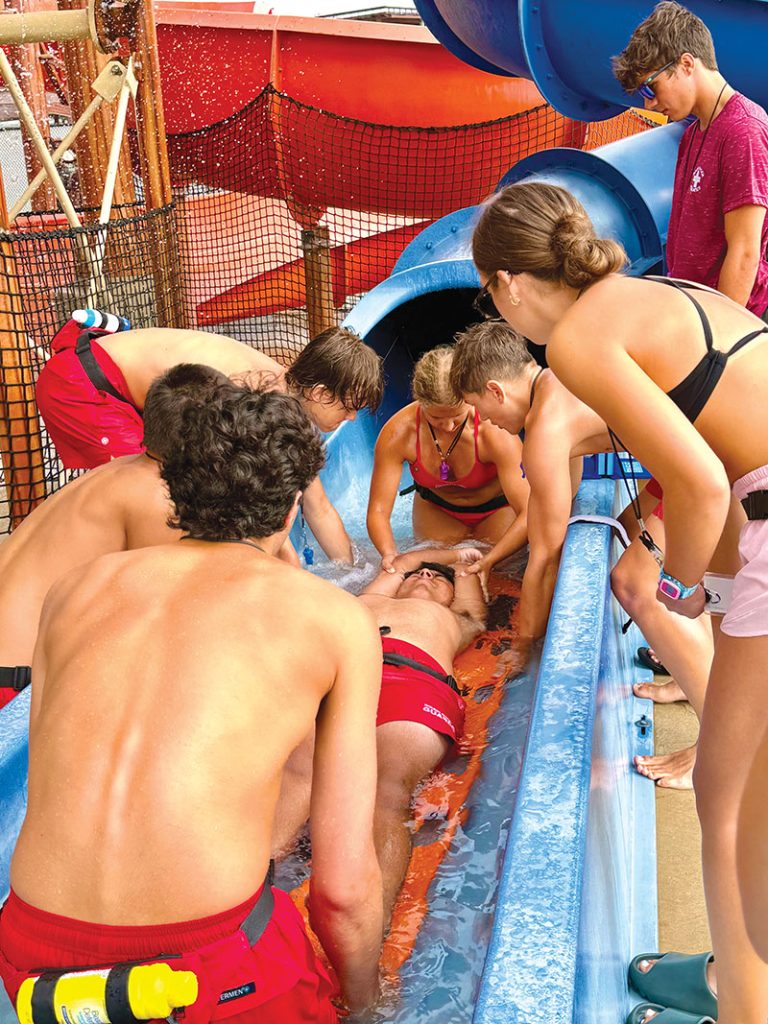
The City of Round Rock, Texas, which operates Rock’N River Water Park, takes an ‘act as if’ approach to training. Lifeguards are expected to behave as if an incident is actually occurring rather than simply demonstrating technique. Teamwork and communication are also assessed during drills. Photo courtesy City of Round Rock